
Advanced Techniques for Detecting and Addressing Cracked Pipes in Modern Infrastructure

Stefani • October 22, 2025

Share this article

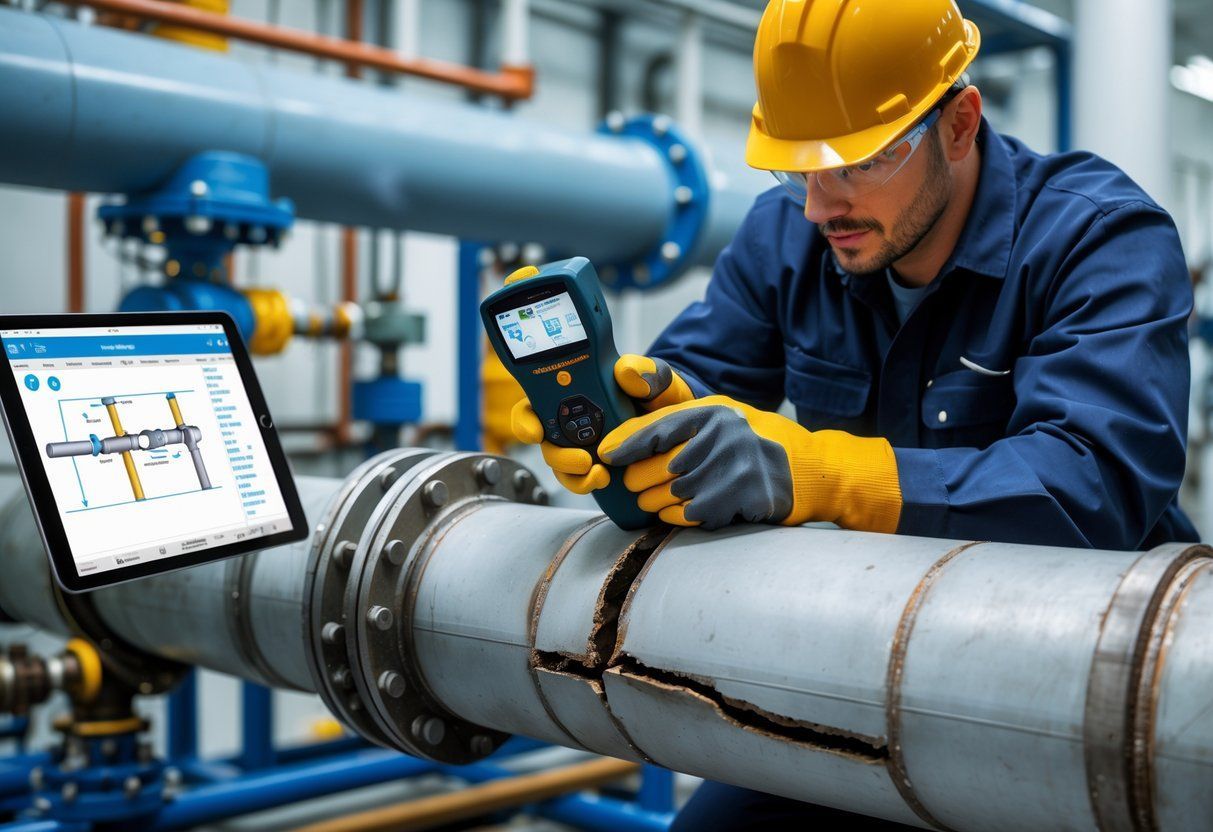
Cracked pipes often go unnoticed until they cause costly damage, but we can prevent that with the right tools and methods. The most effective way to deal with cracked pipes is to detect them early using precise testing techniques. By focusing on accuracy and speed, we can limit repairs and reduce long-term risks.

In this article, we explore both the basics and the advanced approaches that give us a clearer picture of pipe conditions. We move from simple detection methods to non-destructive testing, data-driven analysis, and even machine learning tools that improve accuracy.

Our goal is to show how modern strategies make it easier to identify problems before they grow worse. With a strong understanding of detection and remediation, we can take practical steps to extend the life of piping systems and avoid unnecessary failures.

Fundamentals of Cracked Pipe Detection

We must understand the forms of pipe damage, the difficulties in locating cracks, and how material type changes detection methods. These factors shape how we evaluate the condition of a pipeline system and choose the right inspection tools.

Types of Pipe Defects and Failures

Pipe defects appear in different ways depending on the material, environment, and stress applied. Common issues include longitudinal cracks, circumferential cracks, joint leaks, corrosion pits, and fractures. Each type affects structural integrity differently and may spread if not addressed.

In water pipes, small cracks often begin near joints or fittings due to repeated pressure cycles. Concrete pipes may suffer from surface spalling, reinforcing steel corrosion, or internal voids that weaken the wall. Steel pipes are more prone to corrosion-related thinning, which can lead to rupture under pressure.

We also see failures linked to ground movement, poor installation, or aging materials. For example, clay pipes often break under soil shifts, while plastic pipes may deform under heavy loads. Identifying the defect type helps us match detection methods to the problem.

Challenges in Detecting Cracks

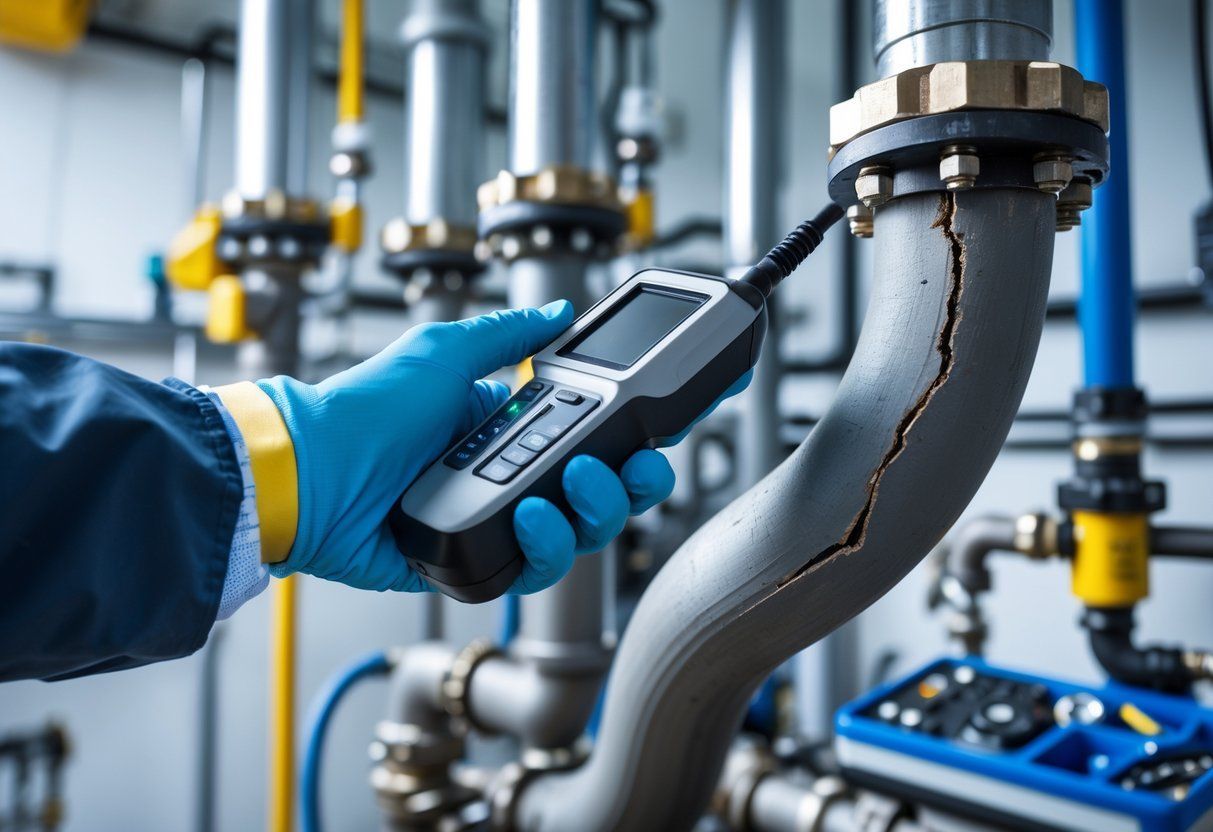
Detecting cracks in a pipeline system is not always simple. Many defects start small and remain hidden until they grow large enough to cause leaks or blockages. Underground water pipes, for example, can leak for months without visible surface signs.

Visual inspection alone often misses fine cracks, especially in concrete pipes where defects may be inside the wall. Acoustic sensors can detect leaks, but background noise from traffic or pumps may interfere. Similarly, pressure testing may confirm a leak exists but not reveal the exact location.

Accessibility adds another challenge. Large pipelines may require robotic crawlers or cameras, but small-diameter pipes limit tool options. Soil conditions, water flow, and pipe depth also affect how well detection methods work. These factors make early crack detection a technical and logistical problem.

Pipe Materials and Their Impact on Detection

Pipe material strongly influences how we detect and interpret defects. Metal pipes often show corrosion, thinning, or stress fractures, which can be measured with ultrasonic testing or magnetic flux leakage tools. These methods work well because metals conduct signals consistently.

Concrete pipes present different challenges. Cracks may be hidden within the wall or masked by surface wear. We often use ground-penetrating radar or impact echo testing to find internal voids or delamination. Reinforcement corrosion inside concrete also requires specialized sensors to measure electrical resistance.

Plastic pipes do not corrode, but they can deform, crack under stress, or fail at joints. Acoustic leak detection is less effective here because plastics dampen sound. Instead, we may rely on pressure monitoring or thermal imaging to spot failures.

By matching inspection tools to the material, we improve accuracy and reduce the risk of missing hidden pipeline defects.

Advanced Non-Destructive Testing Methods

We rely on several advanced non-destructive testing techniques to detect cracks and flaws without cutting or damaging pipes. These methods use sound waves, magnetic fields, or light-based tools to measure changes in material properties and reveal hidden defects.

Acoustic and Ultrasonic Techniques

Acoustic and ultrasonic methods let us detect cracks by sending sound waves through the pipe wall. A transducer generates waves that travel through the material, and sensors capture how the waves reflect or scatter at flaws.

We use bulk waves for localized inspections and ultrasonic thickness testing to measure wall loss. These approaches work well on metals and plastics, including PPR pipes. They provide precise depth information, making them useful for monitoring crack growth over time.

Ultrasonic phased array systems allow us to scan wide areas quickly. By adjusting the angle and focus of the sound beam, we can map defects in three dimensions. This reduces inspection time while improving accuracy.

Guided Wave Propagation and Inspection

Guided wave inspection uses guided waves that travel long distances along the pipe. Unlike bulk waves, these signals move within the pipe wall and reflect back when they encounter cracks, weld defects, or corrosion.

This method is valuable for pipeline inspection where access is limited. We can test several meters of pipe from a single location, reducing the need for excavation. It is especially effective in buried or insulated pipelines.

We often apply guided wave testing in combination with other methods. For example, guided waves can screen a long section of pipe, and then ultrasonic testing can confirm the exact size and depth of a defect. This layered approach improves reliability in defect detection.

Magnetic Flux Leakage and Eddy Current Methods

Magnetic flux leakage (MFL) is widely used in steel pipeline inspection. We magnetize the pipe wall and measure changes in the magnetic field. Cracks or corrosion cause the field to “leak,” which sensors detect.

MFL is common in in-line inspection tools, sometimes called “pigs.” These devices travel through pipelines and record data on wall thinning, pitting, and cracking. The method is fast and effective for large networks.

Eddy current testing (ECT) uses electromagnetic fields instead of direct magnetization. A coil induces currents in the pipe wall, and flaws distort the current flow. ECT works best for detecting surface cracks and is often used in thin-walled tubing or heat exchanger pipes.

Laser Profiling and LiDAR Applications

Laser profiling and LiDAR give us precise measurements of pipe geometry. A laser scans the internal surface, and sensors build a detailed profile. This helps us identify cracks, ovality, or deformation that may not show up with other techniques.

We often use laser tools in pipeline inspection robots that travel inside pipes. These systems capture high-resolution maps of the inner wall, allowing us to track changes over time.

LiDAR is especially useful for large-diameter pipes and tunnels. By measuring reflected light, LiDAR creates accurate 3D models. These models help us locate areas of stress, misalignment, or early crack formation that could lead to failure if left unmonitored.

Data-Driven and Machine Learning Approaches

We can improve crack detection by using data-driven methods that process signals, analyze patterns, and learn from large datasets. These tools allow us to detect small or hidden cracks that are difficult to find with traditional inspection methods.

Signal Processing for Crack Detection

Signal processing helps us analyze vibration, acoustic, or ultrasonic data collected from pipes. By filtering noise and isolating useful features, we can identify irregularities that indicate cracks.

We often use Fourier transforms and wavelet analysis to detect frequency changes caused by structural damage. These techniques make it possible to spot subtle variations in signals that would otherwise be missed.

A simple approach is to compare baseline signals from healthy pipes with real-time measurements. When the system detects unusual shifts, it flags the location for further inspection.

Method Purpose Benefit
Fourier Transform Frequency domain analysis Detects hidden frequency shifts
Wavelet Analysis Time-frequency representation Finds short, sudden anomalies
Filtering Techniques Noise reduction Improves signal clarity

Using these tools, we can create reliable indicators of crack growth before failure occurs.

Deep Learning and Neural Networks

Deep learning models allow us to process large amounts of inspection data with high accuracy. Neural networks, especially convolutional neural networks (CNNs), can learn to recognize crack patterns in both images and sensor data.

We train these models using labeled datasets that include examples of cracked and uncracked pipes. Over time, the network improves its ability to distinguish between normal surface marks and actual cracks.

CNNs excel because they automatically extract features without manual input. This reduces human bias and speeds up analysis. With enough training data, the model can detect cracks at different scales and orientations.

We often combine deep learning with traditional signal processing. This hybrid approach improves detection rates and reduces false alarms.

Automated Visual Inspection Systems

Automated visual inspection systems use cameras, drones, or robotic crawlers to capture high-resolution images of pipe surfaces. These images are then analyzed using computer vision and machine learning models.

A typical system includes:

  • Cameras or sensors for image capture
  • Lighting systems for consistent visibility
  • Software powered by CNNs for crack detection

This setup allows us to inspect large areas quickly without relying only on manual review. Automated systems also provide consistent results since they do not suffer from fatigue or oversight.

We can integrate these systems with real-time monitoring tools. When a crack is detected, the system records its size, location, and severity. This information helps us prioritize repairs and track changes over time.

By combining automation with machine learning, we reduce inspection time while maintaining accuracy.

Condition Assessment and Remediation Strategies

We rely on accurate monitoring and targeted assessment methods to identify pipe damage early and reduce risks. By combining structural health tracking, leakage detection, and specialized tools for buried infrastructure, we improve the reliability of water and gas pipelines.

Condition Monitoring and Structural Health

We use condition monitoring to track changes in pipe performance over time. This includes measuring pressure, flow, and vibration to detect stress or weakening. Structural health monitoring systems provide real-time data that help us understand how pipes respond to daily loads and environmental changes.

Sensors placed inside or around pipelines give us continuous feedback. These devices can detect early signs of fatigue, corrosion, or cracking before a failure occurs. By analyzing this data, we can prioritize maintenance and avoid emergency repairs.

For large water distribution networks and gas pipelines, we often combine monitoring with predictive models. These models estimate the remaining service life of pipes based on age, materials, and operating conditions. This approach allows us to plan replacements and repairs with greater accuracy.

Leakage Detection and Monitoring

Leakage detection is one of the most important parts of pipe condition assessment. Even small leaks can lead to water loss, gas hazards, or soil damage if left unchecked. We use a mix of acoustic sensors, pressure monitoring, and flow balance methods to spot leaks quickly.

Common methods include:

  • Acoustic monitoring to pick up sound waves from escaping fluid.
  • Pressure drop analysis to identify sudden changes in system performance.
  • Smart meters to compare input and output volumes across networks.

Pipeline leakage detection tools can be installed permanently or used during inspections. In gas pipelines, we also apply infrared cameras and gas sniffers to locate leaks more precisely. These technologies help us reduce safety risks and improve efficiency in both water and gas systems.

Assessment of Buried and Inaccessible Pipes

Buried pipes present unique challenges because visual inspection is not possible. We use non-invasive tools such as ground-penetrating radar, electromagnetic sensors, and robotic crawlers to examine these sections. These methods allow us to detect cracks, voids, and corrosion without excavation.

For long stretches of inaccessible pipelines, we often deploy in-line inspection devices. These devices, sometimes called “smart pigs,” travel through the pipe and record wall thickness, deformation, and crack growth. The collected data helps us evaluate structural integrity in detail.

In water distribution networks, buried pipes are also assessed using pressure transient analysis. This technique measures how sudden changes in pressure move through the system, revealing weak spots. By combining these approaches, we can extend the life of underground assets while minimizing costly disruptions.

Recent Posts

Fast Response Plumbing technician servicing a water shut off valve in San Francisco
By Joe Tinsley July 17, 2026
Learn how gate valves, ball valves, and angle stops work, where to find them in your San Francisco home, and when to replace them. FAQs inside.
Budgeting for Unforeseen Sewer Line Maintenance Expenses
By Stefani January 31, 2026
Sewer line problems can hit your wallet fast, and we know the stress of a surprise repair. We show you how to plan a practical budget that covers emergency fixes, regular upkeep, and the big costs that sneak up on you. This saves you money and keeps small issues from turning into major failures. We […]
Seasonal Effects on Sewer Line Maintenance Costs
By Stefani January 30, 2026
You’ll want to know how seasons change what you pay for sewer line maintenance so you can plan ahead and avoid surprise bills. Seasonal weather, ground movement, and plant growth directly affect repair needs and costs, so budgeting by season cuts unexpected expenses. We outline what shifts costs, when repairs most often happen, and which […]
The Role of Location in Sewer Line Maintenance Pricing
By Stefani January 29, 2026
You’ll pay different amounts for sewer line maintenance depending on where your property sits and what’s under it. Location drives cost through factors like soil type, access difficulty, local labor rates, and permit rules, so knowing these lets you predict and plan for expenses. We’ll show how those local details shape quotes and outcomes. We’ll […]
Analyzing Material Expenses for Effective Sewer Line Care
By Stefani January 28, 2026
We’ll break down the real costs that matter for keeping a sewer line working well so you can plan and avoid surprises. You’ll learn which materials and fees drive most of the expense and how small choices can lower long-term costs. We’ll look at costs for parts, tools, permits, and regular cleaning, plus where labor […]
Understanding the Impact of Labor Costs on Sewer Line Maintenance
By Stefani January 25, 2026
You want to know how labor costs shape sewer line care and what that means for your wallet. We will show how wages, crew size, and the repair method you choose change the final bill so you can plan smarter and avoid surprises. Knowing which labor factors most drive costs lets you pick repair options […]
How to Interpret Sewer Line Inspection Reports
By Stefani January 24, 2026
You’ll get clear steps to decode the most important parts of a sewer line inspection report so you can act with confidence. We show you how to spot real problems, what each defect means, and which issues need immediate repair versus routine maintenance. We break the report into simple pieces what the camera images show, […]
Tool kit with hard hat, gloves, laptop, and handheld device on a workbench in a workshop
By Stefani January 23, 2026
You want tools that give clear answers fast so you can find problems and fix them right. We rely on high-quality sewer cameras, locating gear, and cleaning tools to spot cracks, blockages, and defects in sewer lines accurately. Knowing which tools to use helps a plumber save time and avoid costly mistakes. We will walk […]
Worker in blue hard hat inspecting a manhole on a street with a camera device
By Stefani January 22, 2026
You want sewer line inspections timed so they catch problems before they get costly or urgent. We recommend scheduling inspections based on seasonal risks winter freeze, spring thaw, and heavy fall rains because timing cuts repair costs and prevents service interruptions. We will explain how weather, soil movement, and tree roots change the risk level […]
Common Mistakes to Avoid During Sewer Line Inspections
By Stefani January 18, 2026
We know sewer line inspections feel technical and tense, but avoiding a few common mistakes protects your home and wallet. Start by planning the inspection, knowing what to look for, and involving a qualified professional when signs point to trouble. That simple approach cuts down on missed problems and costly surprises. We will walk through […]
Show More